The Sacred Heart in 1954
Thanks to the work of Enrique Moya Casals, *Melilla piadosa y tradicional*, we have an important source of information about the churches that existed in the city at that time.
One of the chapters in your book is dedicated to the Sacred Heart church:
“In this state, the works on the Parish Church of the Sacred Heart of Jesus began in 1911 [as we have seen, they actually started earlier], with 30,000 pesetas that the State released for this pious purpose, and which were invested along with alms from the faithful.
Two years later, an equal amount was used, after a halt in the works; and thus, after various vicissitudes, the undertaking was successfully completed, with the Most Holy Sacrament being solemnly transferred on the third Sunday of May 1918, by the then Bishop of Olympus and Apostolic Administrator of Malaga, Dr. Don Manuel González.
The beautiful Church of the Delphic Sacred Heart of Jesus was designed and overseen by the architect of the Malagan Diocese, Don Fernando Guerrero Strachan, and is, as can be admired at first glance, in the Romanesque style. Its external free surface area is 500 square metres, with a capacity for over two thousand people.
The exterior of the temple is notable for the beautiful silhouette of its style and its location in the best spot in the city. Above a wide staircase appears the church's Romanesque arch doorway, and above it, a wide window with a rose window, bordered at the top, like the doorway, with a beautiful, classic-style border.
Two arched windows increase the light inside, finishing the facade with the bell tower, which are fixed, except for one that swings on great solemnities. The swinging bell is named: “Sacred Heart”, the fixed one “Virgin of Victory”, they were blessed in 1917; the Clock bell, in 1919 and is named “Mary”.
Above the aforementioned body is the clock with four faces, one on each side of the tower, which culminates in a spire. Two small chapels on the sides of this facade are striking, which certainly adorn the ensemble. Adjoining the temple are the presbytery or abbey house and the one dedicated to outbuildings and the archive.
The interior has a basilica plan, albeit of reduced proportions; the temple consists of three naves, the central one with great slenderness, and at the back of which one can admire its notable apse with five elongated windows, in accordance with the architectural style.
The church has two other apses at the back of the chapels of the Immaculate Conception and St. Joseph, covered by altarpieces. This temple contains, in its lunettes, vaults, etc., effective use of light, which shines through a good number of stained-glass windows.
It is accessed on the main altar via five marble steps, and its presbytery, like the entire temple floor, is made of slabs of the same stone. In the centre of the apse stands a reredos with steps and a pedestal that surrounds the altar, and on which is venerated a beautiful image of the Sacred Heart, the patron of the Parish. To the sides, are Archangel Saint Raphael and the Guardian Angel. All of this reredos has today been reformed, as will be stated further on.
A notable Way of the Cross adorns the pilasters of the naves, between the arches of the Temple and the side aisles, and above the first bay is the attached wooden pulpit with its sounding board, which maintains the due harmony with the style of the Church.
It is equipped with an excellent electrical installation, and in the chancel arch, two gilded metal lamps decorate and embellish the main altar, as well as several crystal chandeliers. It also has a complete loudspeaker system.
Following the nave on the right, descending from the chancel, there was until recently a Gothic altarpiece, where the Patron Saint of the Artillery Corps, Saint Barbara, was venerated, who is now in the Military Parish Church.
Subsequently, the images of the Blessed Virgin were placed one after another; one of them, the Miraculous one…
A beautiful Infant Jesus of Prague was also venerated at this altar, and is currently located next to the Baptistery Chapel.
In the following is the Sacramental or Communion Chapel, in whose composite order altarpiece is a pilgrim image of the Purest Conception; together venerated at this altar are Saints Paschal Baylon and St. John the Evangelist, found in the two side niches, amidst beautiful ornamentation of carvings and paintings with emblems and attributes of the Blessed Sacrament. In the upper part, an Ecce Homo painting can be admired.
Two oil lamps illuminate day and night the Blessed Sacrament, reserved on the altar whose tabernacle is covered with the white veil, as prescribed by the sacred liturgy.
Continuing with the Gospel nave is the altar of Our Lady of Mount Carmel, and between the intercolumnia are the images of Saint Rita of Cascia and Saint Anthony of Padua. At the top of this altarpiece, with reminiscences of the Doric style, there is a Carmelite shield.
Following this, there is a side door, covered by a screen, which is opened to the public on specific occasions.
Continuing our tour, we find ourselves in the place where the altar and the image of the Virgen del Pilar are located. Currently, there is an altar dedicated to the Virgin of the Miraculous Medal, which is a new and beautiful image of the Lady. On the sides, Saint Thérèse of the Child Jesus and Saint Cecilia are venerated. Next to the altarpiece is a devotional painting of the Holy Face of the Lord.
At the foot of this side aisle is the Baptismal Font and a chapel with Our Lady of Lourdes, nestled within a small grotto. Our Lady of Montserrat has also been venerated here, and among other devotional saints, there is a painting depicting Saint Onuphrius, to whom there is great devotion in our City. Above the arch of this chapel, we can see an exquisite carved painting of Our Lady of Perpetual Succour.
From this very spot, we proceed to the main door of the Church, which is spacious, as befits the overall monument, and above which is located the choir and a sonorous organ acquired by popular subscription. The parish priest was Don José de Casasola, and the President of the Municipal Council was Don Cándido Lobera, who was the sponsor at the blessing ceremony.
Moving to the nave of the Epistle, we shall venerate a most devout image of the Crucified Lord, with the title of Peace, and before which there are always fervent faithful at its feet. On the table of its altar, votive candles burn continuously, as an offering of the great devotion that exists in Melilla, for such a venerated depiction of the Passion. On a plinth, there is an image of Saint Rosalia.
Next to it, the altar of Our Lady of Sorrows follows, and accompanying Our Lady are Saints Mary Magdalene and Mary Salome. On the front of this altarpiece, we see the coat of arms of Spain and at the pinnacle, the episcopal coat of arms of Olympus, who blessed the temple in the month of May...
Continuing on, we will find the third door of the Church, with a corresponding screen and which is regularly opened during the summer season.
Next is the altar of the Blessed Virgin Mary of the Forsaken, Patron Saint of Valencia, under a Gothic canopy of the finest taste. At her sides and on a smaller plane, Saint Francis of Assisi and Saint Teresa of Jesus.
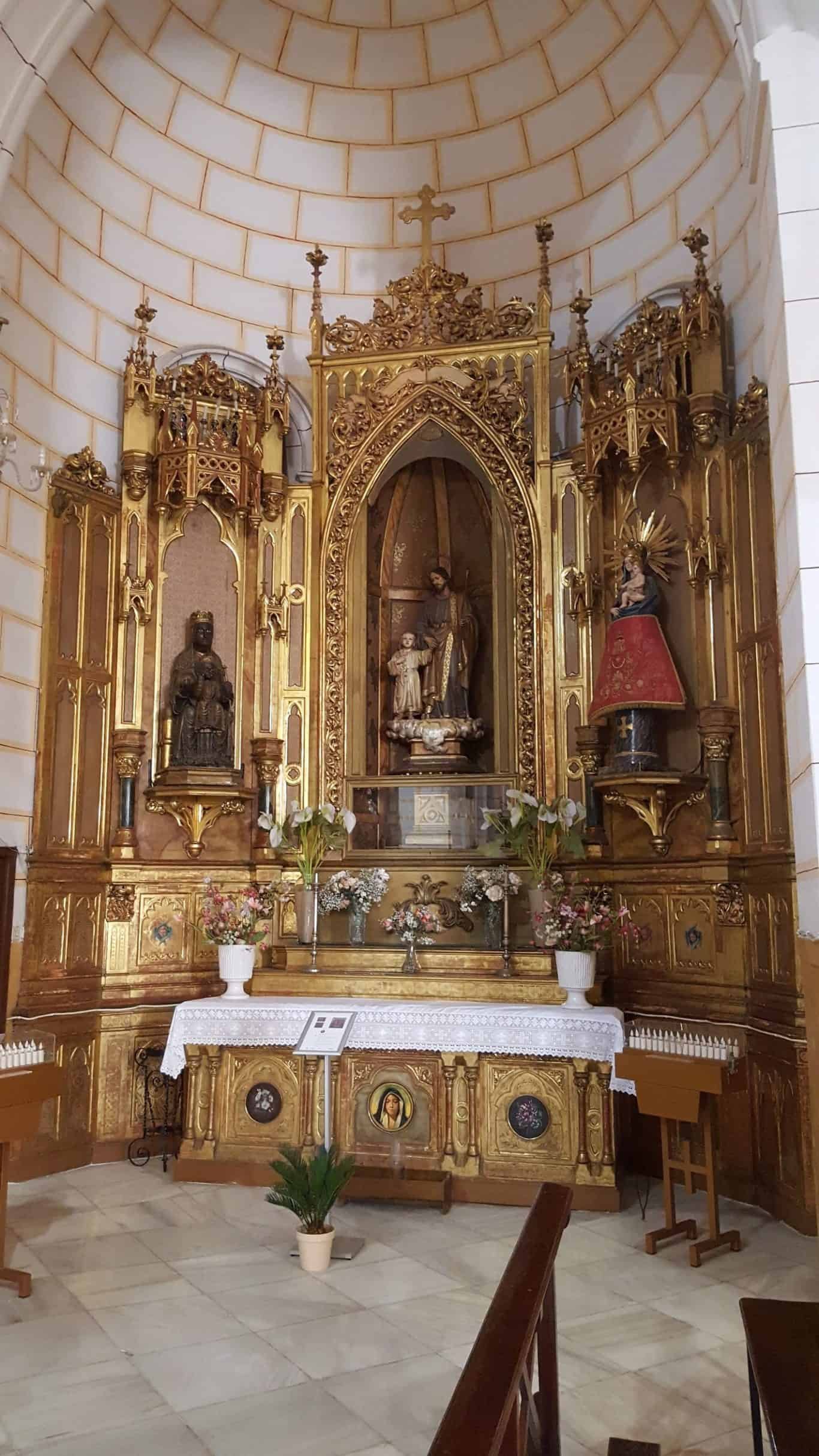
Continuing our visit to the temple, we admired a beautiful altarpiece in honour of Patriarch Saint Joseph. Next to the patron of this altar, the images of Saint Lucy and the Most Holy Virgin of Peace are venerated, and on the right-hand wall a devout effigy of the Virgin of Charity, Patron Saint of Cartagena, has recently been placed, and on the opposite there is a painting of the Virgin of Sorrows, Patron Saint of Granada and an image of Saint Pancras. Finally, we will say that on the steps of Saint Joseph's altar, an effigy of Our Lady of Montserrat is venerated, Patron Saint, as is known, of the ancient Principality of Catalonia.
From the altar of Saint Joseph, we moved to the exquisite Gothic altarpiece of Our Lady of Perpetual Succour, for whom there is also genuine faith in Melilla. A group formed by two angels and seraphim raise the beautiful painting of the Virgin, crowned with a royal diadem. On either side and above canopies, the devout images of Saint Alphonsus Maria de Liguori and Saint Louis Gonzaga are admired.
The antependium or frontal is made up of columns in the same style as the altar. Following this order, we will proceed to the sacristy of this church, which is small and more internal; a room for meetings and conferences has recently been built.
Opposite the sacristy is the new chapel of Our Lady of the Pillar, thanks to the zeal of the then Parish Priest, Don Sebastián Carrasco, currently Vicar General of the Diocese.
As we said at the beginning, this small sanctuary is found at the head of the Gospel nave. Its decoration is related to the style of the Church, and the angles, dado, and frieze have been sumptuously decorated in imitation of veined marble, which enhances the austerity of the place.
An indirect light illuminates the ceiling of the Chapel at night, where the Apparition of the Virgin is depicted, above the sacred column and among several cherubs.
In the four corners, the allegories of the Holy Evangelists have been painted, and interpolated can be seen: the Ship of the Church, the Divine Lamb; an Allegory of the Virgin with the first words of the Angelus and the Most Holy Eucharist in the central part.
The altar is the same as the one found in the previous location, which, situated in this spot, is enhanced with greater beauty and style, and upon whose throne the Heavenly Queen and Mother is once again venerated between two angels…
Some years before being promoted to the dignity of Cantor of Málaga Cathedral, and later, as we know, to that of Dean, the Most Illustrious Mr. D. Sebastián Carrasco Jiménez, undertook with determination and true artistic taste the reform of the presbytery and the high altar, as we see it today. He provided a choir, completely isolated the altar table, and next to two adoring Angels, erected the tabernacle-monstrance for the Blessed Sacrament, and placed at the back of the Romanesque apse, above a short altarpiece, the most venerated Image of the Sacred Heart of Jesus, the Patron of the Archpriestly Church of Melilla.
It also furnished the presbytery with a new wooden balustrade and the two ambos or pulpits, as we see them today.
These reforms are being completed with the two altars, in honour of the Virgin of Fatima and the Immaculate Heart of Mary.
Recently, two beautiful altars have been placed at the entrance to the Archpriest's church. The one on the left is dedicated to Our Lady of Solitude, whose altarpiece features a relief of a pierced heart at the top. On the right side, there is a similarly artistic altar dedicated to Our Father Jesus the Nazarene (commonly known as Medinaceli). To the sides, and on two pedestals, are the images of Mary Help of Christians and Saint John Bosco. In the upper part of the altarpiece is a sorrowful Virgin, painted in oils.”
[Bibliography: Enrique Moya Casals. Melilla piadosa y tradicional. Historical and artistic description of the city's temples. Melilla. 1954]
Isabel Migallón Aguilar. From the Church of Llano to the Sacred Heart of Jesus. Centenary of the Consecration of the Temple (1918-2018). Confraternities of Melilla. 2019]